
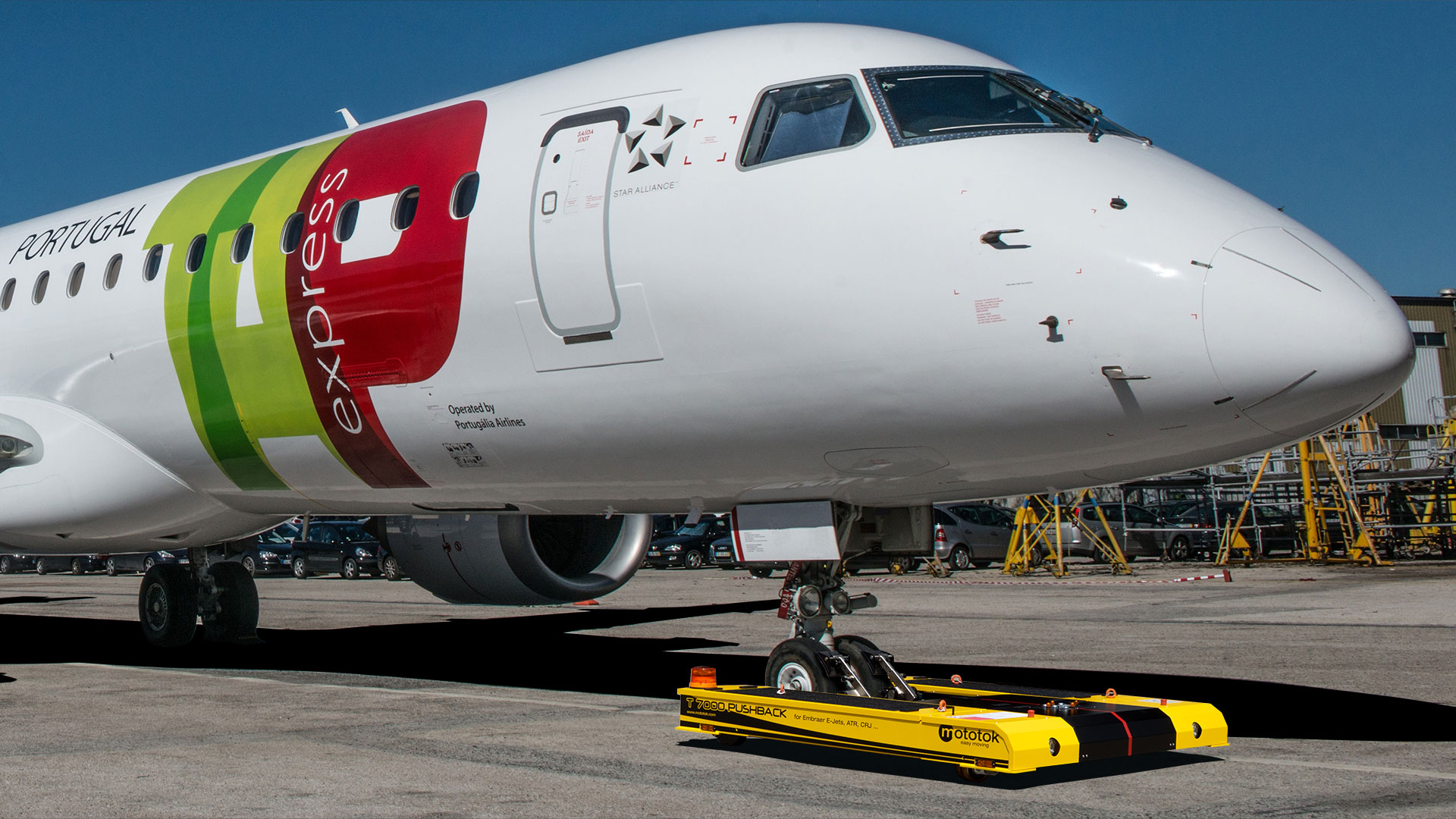


From conventional tractors with a tow bar, via towbarless sit down tugs or towbarless tugs with a rotary table, to towbarless, remote-controlled tugs, there is a whole variety of different tug systems for aircraft towing available. How, then, do you choose the right aircraft tug for your operations and what are the advantages of electric, towbarless, and remote-controlled tugs? Learn more in our guide to selecting the right towing tools for efficient and safe aircraft handling.
Types of Aircraft Tugs: What Different Aircraft Towing Tools are there?
There are basically four different types of tugs for aircraft towing available:
- conventional tractors with a tow bar
- towbarless sit down tugs
- towbarless tugs with a rotary table
- towbarless, remote-controlled aircraft tugs
It can further be distinguished between engine-powered tugs, such as conventional diesel tractors, hybrid systems, and battery-powered, fully-electric aircraft tugs.
As we have discussed in our blog post “Mototok Aircraft Tugs: Business Case Example for the Acquisition”, fully-electric, towbarless, and remote-controlled Mototok tugs have several advantages that outperform other aircraft tugs in the industry worldwide. However, let’s take a closer look at the key criteria to consider when choosing an aircraft towing tool for your ground handling operations.
What are Key Criteria in Selecting the Right Aircraft Tug for your Ground Handling Operations?
Aircraft tugs come in all shapes and sizes and the specific features required depend on their purpose and application area. Yet, it can be said with some certainty that electric, towbarless, and remote-controlled aircraft tugs are the future of ground handling, whereas conventional diesel tractors with a tow bar have slowly but surely become a relic of an outdated technology.
In this guide to choosing the right aircraft towing tool, we have gathered key criteria worth considering before the acquisition:
Precise Maneuverability and Ease of Use
While a towbarless sit down tug has without doubt several advantages compared to a conventional tractor with a tow bar, both have one major disadvantage in common: With these tugs, operators are in a fixed position, that is, they have no overview from their position and must necessarily look away from the aircraft to see where they are driving. They therefore require two or three wing walkers to guide them when moving the aircraft and to watch the wings and fuselage, especially in tight areas. In addition, these tug types require the cockpit to be occupied by a pilot to brake if necessary.
Ground handling operations with normal tugs, with or without a tow bar, are intricate and leave much to be desired. With both a conventional tractor with a tow bar and with many other towbarless tugs, maneuvering the aircraft means “steering by moving” and requires extensive space. The gross motor skills deny clever parking and small turning circles, especially when using tugs with a tow bar.
Towbarless and remote-controlled Mototok tugs, in contrast, are unparalleled in their precise maneuverability and ease of use. They are easy to maneuver and require no special license, nor extensive training. The industrial radio remote control with worldwide safety approval, also for airports, allows the operator to move freely around the aircraft, enabling a circumferential view.
Mototok tugs can therefore be safely operated by a single person, with no additional wing walker required. Remote-controlled tugs also allow the operator to move the aircraft with controlled speed and brake to the exact point, with no pilot in the cockpit required. This is not only a significant advantage in terms of cost efficiency, reducing personnel costs, but also highly beneficial in times of staff shortages.
Connection to the Nose Gear
With a conventional tractor, every airplane type requires a specific tow bar to connect to the aircraft. This does not only require storage capacity for towbars and clutter in and out of the hangar, but also makes spontaneous maneuvers impossible. With towbarless tugs, winches, straps, or adapters are often needed for fixation and towbarless tugs with a rotary table, as well, do not automatically fix the nose gear. In each case, the process of engaging or disengaging the nose gear is cumbersome, time consuming, and requires physical effort.
In contrast, Mototok Twin and M-Series tugs are compatible with 99 percent of all corporate aircraft and Spacer 8600 tugs are compatible with all narrowbody airliners, whether single or double wheel, and most wheeled helicopters. Mototok tugs load and unload the nose gear quick, safe and simple in a largely automated process with a hydraulic and sensor-monitored system unique in this class of aircraft tugs, no winch or lashing strap, nor physical effort required – the operator only needs to press a button on the remote control. With this automatic process, loading or unloading the nose gear only takes 10 to 15 seconds and thus significantly increases time efficiency.
Aircraft Safety and Risk of Injuries
Maneuvering aircraft with a conventional tractor with a tow bar or a towbarless sit down (particularly with a cabin) tug involves an increased level of risk of accidents and damage to the aircraft or ground support equipment (GSE). For instance, miscommunication between operator and wing walkers can lead to collision with other aircraft or objects. Tunnel vision experienced by the tug operator in the enclosed space of the tug cabin further attributes to this risk. Accidents often occur not because the wing walkers didn’t signal, but because the operator wasn’t paying attention. Given the physical effort in (dis)-connecting the nose gear, there is both risk of damage to the aircraft as well as risk of injury.
While most of these accidents are, of course, due to human error, they can be almost entirely avoided with a Mototok tug. Since there is virtually no chance the operator could get hurt while (dis-)engaging the nose gear, Mototok tugs minimize the risk of injuries, thereby preventing avoidable medical costs and sick leaves for several weeks at a time, as well as insurance rate increases.
Moreover, remote-controlled, towbarless Mototok tugs can significantly increase operational and aircraft safety, as we have discussed in our blog post “Ground Handling’s Role in Enhancing Aircraft Safety”. For instance, the fact that the operator can move freely around the aircraft and see every vulnerable point, significantly reduces the risk of hangar rash. In minimizing risk exposure of both operators and aircraft, Mototok tugs render ground handling operations more efficient.
Hangar Efficiency
With a conventional tractor with a tow bar or a towbarless sit down tug, parking aircraft in the hangar is rather cumbersome. In both cases, space for uncoupling the tug as well as an exit path for the vehicle needs to be considered. Usually, the aircraft has to be parked backwards so that the tractor or sit down tug can be removed afterwards. With a towbarless sit down tug, more space-saving parking is only possible with larger aircraft that have sufficient clearance below the fuselage. In any case, valuable parking space in the hangar is lost, resulting in loss of revenue in parking fees.
Thanks to their remote-controlled precision and towbarless design, Mototok tugs allow you to safely park aircraft in a space-optimized way in tight areas and even in the last corner of the hangar. Given the compact design of these tugs and the automatic nose gear loading, there is no need to consider or clear an exit path, nor any extra space for (dis-)connecting the nose gear. Mototok tugs can therefore optimize hangar capacity up to 60 percent, allowing operators to park more aircraft. Moreover, compared to other tugs, Mototoks access aircraft in the hangar more than twice as quickly and a typical hangar to ramp movement only takes 3 minutes on average.
Tip: We offer free hangar efficiency consultations, just contact us.
Maintenance Costs
Conventional tugs running on fossil fuels have a high maintenance level due to the combustion engine, which require fuel and oil and regular replacement of parts. In contrast, Mototok tugs are virtually maintenance free in daily operation, minimizing maintenance costs.
The average life span of the batteries is six to seven years and replacement costs are minimal compared to other electric tugs. If there should ever be a problem with your Mototok, the built-in diagnostic system allows the operator to immediately troubleshoot the problem and our techs are readily available to help you solve it. Mototok tugs are specifically designed to allow for quick and easy replacement of parts and our techs can guide you through the process, with no on-site specialist required.
Sustainability
Fully-electric Mototok tugs are the eco-friendly alternative to conventional diesel tugs or hybrid systems. In allowing you to electrify your ground handling operations, electric aircraft tugs help airports achieve their sustainability goals. With sustainability increasingly becoming a focus in the aviation industry, electric ground support equipment (eGSE) is one of the key trends in aviation in 2026.
Additionally, electric tugs are not only the more sustainable choice for our environment – they also improve the air quality at your airport and, thus, the working conditions of your ground handling staff.
Application Areas
Which aircraft tug is the perfect choice for your operations also depends on the application area. We will here focus on a very brief overview of different Mototok models and their respective field of application:
- M-Series tugs are compatible with light aircraft and most wheeled helicopters up to 28 tonnes or 61,700 lbs, including smaller business jets with single or double nose wheels, recreational airplanes and turbo props. M-Series tugs are Mototok’s entry-level solution for Maintenance, Repair and Overhaul (MRO) facilities and fixed-base operators (FBOs).
- TWIN-Series tugs are compatible with a wide range of aircraft up to 75 tonnes or 165,300 lbs and most wheeled helicopters, including regional aircraft and medium to large business jets with single or double nose wheel. TWIN-Series tugs are Mototok’s most popular model series for MROs and FBOs. The T7000 is a model option for commercial terminal pushback operations.
- SPACER-Series MRO tugs are compatible with narrow-body as well as wide-body aircraft up to 200 tonnes or 440,924 lbs, including regional and bigger business aircraft. SPACER-Series tugs are the ideal choice for MROs maintaining narrow-body and wide-body aircraft.
- The pushback tug SPACER 8600 NG is compatible with the most important short-haul aircraft up to 105 tonnes or 231,485 lbs and is the state-of-the-art solution for pushback operations.
- LB-Series tugs are specifically designed for military purposes and are compatible with military aircraft up to 75 tonnes or 165,350 lbs and most helicopters. These tugs are the ideal choice for military aviation operations by the navy, air force, and army, including offshore operations.
- Alligator-Series tugs are for wheeled helicopters with single or double nose wheel up to 50 tonnes or 110,231 lbs. These are the most compact electric and towbarless tugs worldwide and dock easily under helicopters with low ground clearance. These helicopter tugs are ideally suited for police aviation and air medical services and can also be adapted for offshore operations.
Conclusion: How to Choose the Right Tug for Aircraft Handling
There is a whole variety of aircraft towing tools for aircraft handling available. However, conventional diesel tractors with a tow bar have slowly become a relic of the past, while the advantages of fully-electric, towbarless, and remote-controlled aircraft tugs clearly make them the future of ground handling. With sustainability becoming ever more important in the aviation industry, eGSE will gain further in importance and is the most future-oriented choice.
Which aircraft tug is the ideal choice for your ground handling operations also depends on the application area. However, there are, in any case, certain key criteria worth considering before the acquisition. These include maneuverability and ease of use, how the tug connects to the nose gear, aircraft safety and risk of injury, hangar efficiency, maintenance costs, and sustainability. Mototok tugs outperform other tugs in terms of efficiency, safety, and sustainability.
If you are interested in finding the perfect Mototok model for your aircraft handling, just contact us – we’re happy to help.

FAQ: Frequently Asked Questions on Choosing the Right Aircraft Tugs
What Types of Aircraft Tugs are there?
It can basically be distinguished between four types of aircraft tugs: conventional tractors with a tow bar, towbarless sit down tugs, towbarless tugs with a rotary table, and towbarless, remote-controlled aircraft tugs. Additionally, it can be differentiated between engine-powered tugs using fossil fuels, hybrid systems, and battery-powered, fully-electric aircraft tugs.
What Criteria should be Considered when Choosing an Aircraft Tug for your Ground Handling Operations?
When choosing an aircraft tug for your ground handling operations, key criteria include the precise maneuverability and ease of use of the tug, how the tug connects to the nose gear, aircraft safety and risk of injury, hangar efficiency, maintenance costs, and sustainability. Electric, towbarless, and remote-controlled Mototok tugs are the sustainable alternative to conventional diesel tugs and virtually maintenance free in daily operation. These aircraft tugs help airports optimize hangar efficiency and outperform other tugs, such as conventional tractors with a tow bar and towbarless sit down tugs with their remote-controlled precision and safety as well as quick and automatic nose gear loading.
What Aircraft Tugs are a Sustainable Solution for Ground Handling?
Fully-electric Mototok tugs are a sustainable solution for ground handling operations and are the eco-friendly alternative to conventional diesel tugs. As sustainability is increasingly becoming a focus in the aviation industry, electric ground support equipment (eGSE) is currently one of the key trends in aviation, contributing to a greener future.
What Aircraft Tugs are the Future of Ground Handling?
Fully-electric, towbarless, and remote-controlled aircraft tugs are the future of ground handling. These tugs outperform other tugs, such as conventional tractors with a tow bar or towbarless sit down tugs with their remote-controlled precision, unparalleled safety, and zero emissions. Their advantages render ground handling operations more efficient, reducing costs and increasing revenue with airport operations.
Comments