
:%20Aviation%20Trends%202026&picture=https://1835281.fs1.hubspotusercontent-na1.net/hubfs/1835281/img/hero/Spacer8600NG-Embraer-Pushback-L.webp&description=The%20transition%20towards%20sustainable%20aviation%20is%20gaining%20momentum.%20Explore%20with%20us%20eGSE%20as%20a%20key%20trend%20in%20ground%20handling%20in%202026.)
:%20Aviation%20Trends%202026&picture=https://1835281.fs1.hubspotusercontent-na1.net/hubfs/1835281/img/hero/Spacer8600NG-Embraer-Pushback-L.webp&description=The%20transition%20towards%20sustainable%20aviation%20is%20gaining%20momentum.%20Explore%20with%20us%20eGSE%20as%20a%20key%20trend%20in%20ground%20handling%20in%202026.)
As sustainability is increasingly becoming a focus in the aviation industry, the transition towards sustainable aviation is gaining momentum. Electric ground support equipment (eGSE) plays a vital role in this transition and 2026 might, in fact, likely be a turning point for ground handling operations. Explore with us some key trends in the aviation industry’s ground handling practices to look for in 2026.
Given the aviation industry’s goal of achieving net zero carbon emissions from their operations by 2050, sustainability is among the key trends and innovations currently shaping the future of aviation. In our blog post “Top 3 Sustainability Trends in Aviation to Look for in 2025”, we have discussed three major trends that were set to shape a greener future in aviation in 2025 and will, of course, continue to do so in 2026:
- Sustainable Aviation Fuels (SAF),
- new aircraft technologies
- as well as sustainable logistics solutions for green airports.
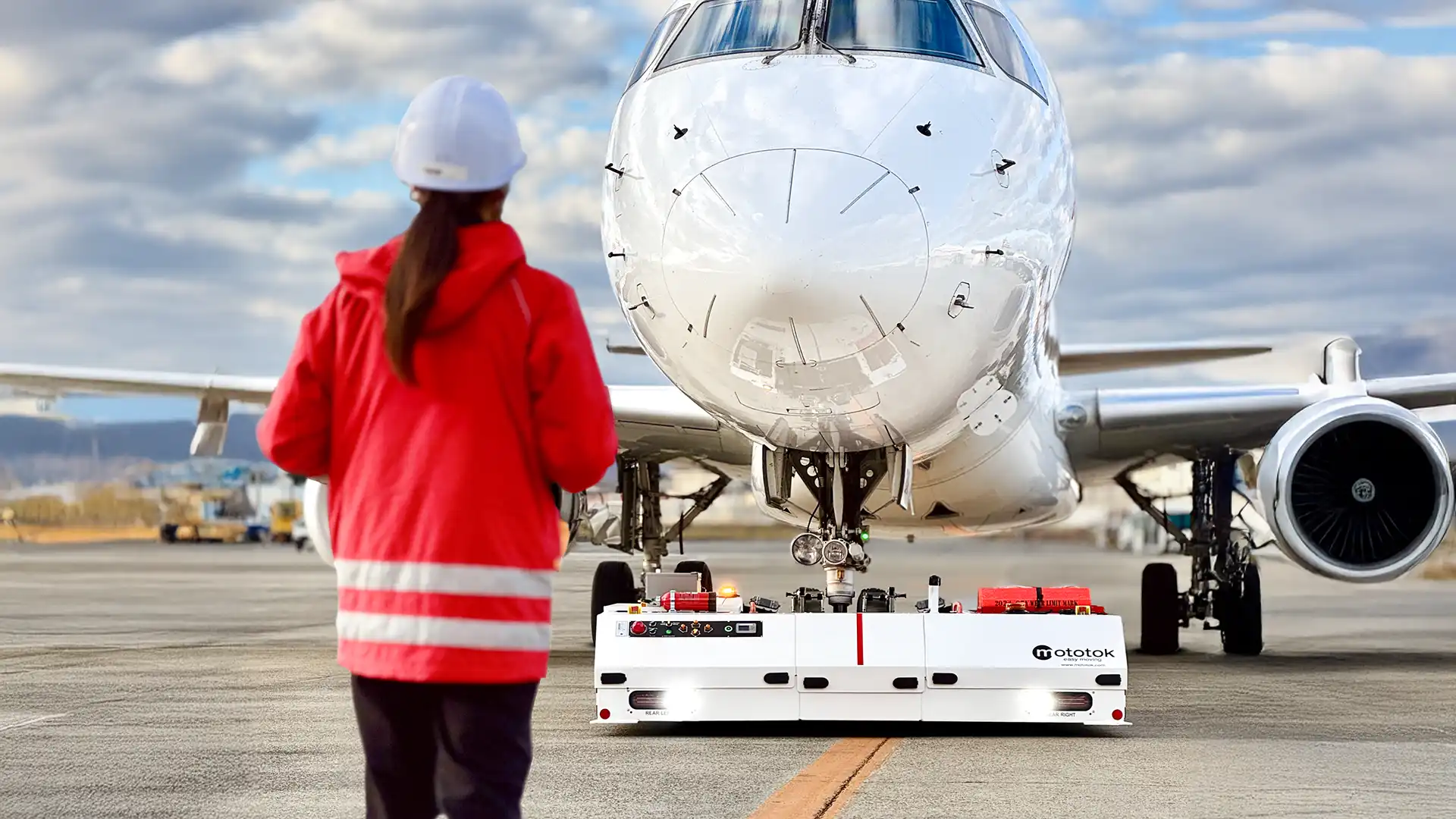
While some trends and innovations – such as completely clean, i.e. electric aircraft – are still very much in the future, electric ground support equipment, such as fully-electric aircraft tugs, is already available today. eGSE does not only provide an essential starting point for the aviation industry to minimize its carbon footprint, but it’s fair to say that without it, there will be no sustainable aviation in the long run. So, let’s take a closer look at the trend of electric GSE, and more specifically electric aircraft tugs: What developments in airport operations can we expect in 2026?
Ground Handling Trends in Aviation to Look for in 2026: Electric GSE (eGSE)
Perhaps, there have already been noticeable changes in your airport’s ground handling operations? In any case, the electrification of GSE has seen significant progress over the past several years. Fully-electric aircraft tugs with zero emissions, for instance, are the sustainable and silent alternative to conventional diesel tugs and are increasingly replacing their noisy, disruptive, and polluting counterparts in ground handling operations.
What Are the Main Advantages of eGSE?
The key advantages of eGSE become most apparent once one considers the numbers: According to a recent study by the International Air Transport Association (IATA) that was conducted based on an average EU country, eGSE, compared to traditional GSE, per turnaround produces
- 35% to 52% less CO2 emissions
- and up to 5.5 to 8.3 dB(a) lower noise emissions.
Electric GSE such as electric aircraft tugs revolutionize ground handling operations by effectively reducing greenhouse gases and pollutants, thereby contributing to achieving airports’ sustainability goals. With zero carbon emissions and a significant noise reduction, electric aircraft tugs also create a healthier working environment for ground handling crews. Significantly reducing noise emissions, electric GSE additionally enables quieter operations and better communication among ground crews, thus reducing the risk of accidents due to miscommunication.
Another advantage of electric GSE are reduced operating costs compared to traditional diesel tugs, as carbon and fuel prices continue to rise. Moreover, eGSE has a much lower need for maintenance, saving airports high amounts of costs as well as rendering operations more time-efficient. For instance, unlike conventional diesel tractors, fully-electric Mototok tugs are virtually maintenance-free in daily operation, thus requiring low to no maintenance costs.
Fully-electric, towbarless and remote-controlled Mototok tugs come with further advantages:
- Enhancing operational efficiency and safety: Mototok tugs connect to the aircraft with an automatic hydraulic and sensor controlled system, which renders the process of loading and unloading the nosegear quick, simple and safe – it only takes 10 to 15 seconds. Thanks to their towbarless and compact design, Mototok tugs, moreover, access aircraft in the hangar more than twice as quickly than conventional tugs with a towbar and their remote-controlled precision enhances aircraft safety.
- One person operation: Given their towbarless design and remote control-feature, Mototok tugs are easy to maneuver and require no special license, nor extensive training. With the remote control enabling unobstructed, circumferential view, these tugs can, moreover, be safely operated by a single person, thus reducing the need for ground handling staff in times of labour shortages.
Electric aircraft tugs can thus also help airports improve their operational efficiency and on-time performance – an aspect that is of vital importance, given that global passenger numbers are expected to surpass pre-pandemic volumes in 2026.
Electric GSE and Fully-Electric Aircraft Tugs as a Growth Market
The process of transitioning to eGSE will, of course, not happen overnight and is much more complex than merely having to replace traditional GSE. For instance, eGSE also requires the airport to have a sustainable charging infrastructure. Nonetheless, various forecasts for the period from 2025 to the 2030s leave no doubt that with the increasing adoption of ‘green airport’ initiatives worldwide, both electric GSE in general, and fully-electric aircraft tugs in particular, are a growth market with enormous potential.
Today, electric GSE is already becoming the default choice for new acquisitions. The question is no longer whether to electrify your ground handling fleet, but how to do so effectively. Both the acquisition of eGSE and of the infrastructure required are already being supported by electrification program grants offered by airport authorities as well as by federal and international funding programs designed to help airports in transitioning to more environmentally-friendly operations. In our blog post “Airport Electrification: Program Grants for Tenants”, we provide a brief overview of some selected funding programs available.
Further Aviation Trends to Look for in 2026: Automation of Ground Handling Operations
With an ever increasing importance of artificial intelligence and automation across all industries, another trend to look for in 2026 concerns the automation and standardization of airport operations and ground handling practices.
Autonomous guided vehicles (AGVs) will undoubtedly be the future of ground handling and pushback operations and are already beginning to revolutionize these operations. While AGVs will, of course, always have human oversight and override control, they almost entirely eliminate the risk of human error from the equation, and have thus the potential to clearly enhance aircraft safety. In addition to standardizing ground handling processes and ensuring higher safety for both aircraft and personnel, AGVs will significantly reduce operating costs and optimize turnaround times.
As of 2026, it is therefore only a matter of time before autonomous tug will become the standard principle. In fact, the future is already here: Mototok tugs are already equipped with optional AGV capability, enabling pushback operations and parking procedures to be carried out autonomously and with the highest precision.
Conclusion: Ground Handling Trends to Expect in 2026
With the aviation industry’s goal of achieving net zero carbon emissions by 2050, the transition towards a greener future in aviation is likely to gain further momentum in 2026. In fact, 2026 might likely be a turning point for ground handling operations, as sustainability metrics, such as CO2 emissions per turnaround and the use of electric ground support equipment (eGSE), will gain further in importance.
Electric ground support equipment will play a vital role in the transition towards sustainable aviation and ‘green airports’. Electric GSE, such as fully-electric aircraft tugs, moreover, has central advantages compared to conventional tugs, rendering ground handling operations more efficient, safe, and sustainable. The transition towards electric GSE is supported by electrification program grants.
In addition to eGSE, another key trend in ground handling to look for in 2026 are autonomous tugs or autonomous guided vehicles (AGVs). With a Mototok tug, the future is now: If you’re interested in increasing the sustainability of your ground handling operations with our fully-electric tugs or in learning more about AGV capabilities, just contact us – we’re happy to help.
Comments