
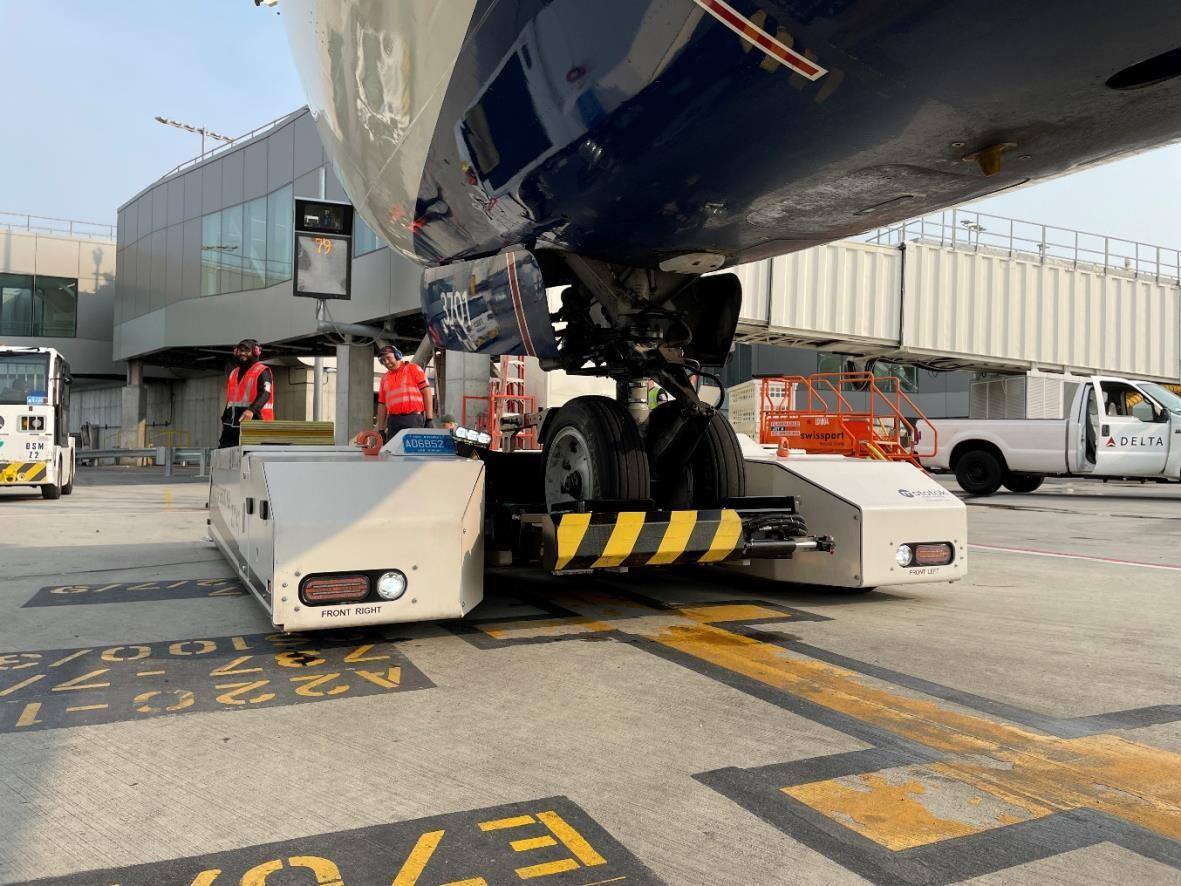


As airports and airlines shift the ramp toward electric ground support equipment, operations leaders face a familiar hurdle: proving the investment in numbers a finance committee will accept. Fuel savings are just the tip of the iceberg.
Why you must measure more than fuel savings with eGSE
Airports, airlines and ground handlers increasingly agree that the future of the ramp is electric. Yet investment committees still ask: "How do we know this will pay off?" Replacing diesel tractors and legacy tugs with electric ground support equipment (eGSE) and electric aircraft tugs is a significant CAPEX decision. To make electrification part of the core CAPEX plan, operations leaders need to demonstrate its impact in hard numbers.
The challenge is that many business cases focus too narrowly on diesel versus electricity costs and payback periods. In reality, electric GSE can also improve safety, punctuality, labour productivity, maintenance and overall operational performance. Without these factors, even strong projects can struggle to convince CFOs.
A focused KPI framework tailored to electric GSE can help. Specialist providers such as Cosmos Solutions highlight the value of combining turnaround time, delay minutes, incident rates, resource utilisation and SLA performance to make ground operations measurable: Cosmos article on KPIs for aviation ground operations. Adding equipment-specific metrics for electric tugs makes it possible to isolate the impact of electrification and build a stronger case for scaling.
For electric aircraft tugs, five KPI families are particularly relevant: turnaround and delay metrics, safety and ground damage indicators, equipment and maintenance performance, labour productivity and emissions. Combined with station-level financials such as cost per turn, cost per block hour and on-time performance penalties or incentives, these KPIs provide a comprehensive picture of the value of replacing diesel, towbar-based tractors with remote-controlled, towbarless electric tugs such as Mototok’s Spacer or TWIN series: Mototok guide to choosing towing tools.
Core operational, safety and sustainability KPIs for electric tugs
Electric tugs eliminate diesel during towing and pushback – but stopping there leaves most of the value on the table. A complete KPI set covers four dimensions: operational performance, safety and quality, financial impact and sustainability.
- Turnaround time (TAT) by aircraft type and station: ground handling delays are one of the top three drivers of late departures, with standardised procedures and modern GSE as key mitigations: IATA article on turnaround efficiency. Towbarless tugs speed up coupling/decoupling and often enable true one‑person towing.
- Pushback duration, variance and ramp‑attributable delay minutes before and after deployment – the quickest way to see whether the theoretical advantage plays out in your environment.
- Safety metrics: towing‑related incidents per 1,000 departures, near‑miss reports on aircraft movements, and the share of ground damage where GSE is a primary or contributing factor. IATA's 2024 ground handling priorities note that Enhanced GSE – including electric tugs with anti‑collision and inching features – can cut ground damage costs by more than 40 %: IATA Enhanced GSE press release.
- A simple damage taxonomy: separate nose‑gear, fuselage and wingtip events, and whether they occurred during pushback, gate repositioning or hangar movements. Because towbarless tugs cradle the nose gear and give the operator 360° visibility, this is usually where improvements show first.
- Process KPIs: SOP adherence (defined walking paths, speed limits, stop points), training completion rates and operator proficiency – remote control replaces a driver plus wing‑walker with one operator walking alongside the aircraft.
- Timestamped event data: chocks in, tug connected, push approved, tug clear – to pinpoint micro‑delays and deviations: Cosmos article on ground operations KPIs. Electric tugs with integrated data logging make this analysis far easier than legacy tractors without telemetry.
Turning data into a business case and continuous improvement
Once you have defined your KPI set, the next step is to turn the data into a credible business case – ideally before committing to a full fleet replacement. Start with a pilot: deploy one or two electric towbarless tugs in a defined area and run them alongside existing equipment for several months. Collect the same KPIs for both equipment types to enable a direct comparison.
The financial layer should clearly separate costs and benefits. Costs include the tugs and chargers, training, maintenance and electricity. Benefits include fuel savings, reduced maintenance, avoided maintenance on ageing tractors, and the value of fewer delays and ground damage. AviationPros estimates the average direct repair cost of a ground damage event at around USD 18,000, while disruption costs can be several times higher: AviationPros article on aircraft ground damage costs. IATA projects that industry-wide ground damage costs could reach USD 10 billion annually by 2035, highlighting the potential savings: IATA Enhanced GSE programme statement.
Case studies provide useful benchmarks for validating assumptions. Munich Airport’s all-electric wide-body pushback tractor demonstrates how energy and maintenance savings can combine with improved towing performance: all-electric pushback tug at Munich case study. Mototok’s business case example shows annual savings in the low six-figure range when ground damage, personnel efficiency, maintenance and hangar utilisation are considered: Mototok business case example. These examples can serve as useful sanity checks for your own calculations.
Sustainability metrics add another important dimension. Electric GSE can provide measurable CO2 reductions and support airport and airline net-zero targets. IATA explicitly identifies the transition to electric or biofuel-powered GSE as part of its sustainability roadmap: IATA ground operations sustainability roadmap. By converting diesel consumption into grams of CO2 per turn and comparing this with the footprint of your electricity mix, you can quantify the emissions avoided.
Finally, make the KPIs part of a continuous improvement loop rather than a one-off project. Dashboards should track performance against targets, electric tug utilisation and safety indicators. As ramp digitalisation advances – from connected tugs to video analytics – your KPI set can evolve. The principle remains simple: measure what matters, demonstrate the impact and use the results to accelerate the shift to safer, cleaner and more efficient ground support equipment.
FAQ:
Fuel savings only capture a small part of the value of electric ground support equipment. The real business case includes safety improvements, reduced ground damage, better turnaround times, higher labour productivity, and measurable sustainability gains — factors that are essential to convince finance committees.
The five core KPI families are: turnaround and delay metrics (e.g. average pushback duration), safety and ground damage indicators, equipment and maintenance metrics, labour productivity figures, and emissions data. Combined with station-level financials, these KPIs show the full impact of switching to electric tugs.
According to IATA's 2024 ground handling priorities, enhanced GSE — including electric tugs with anti-collision and inching features — can cut ground damage costs by more than 40%. This is significant given that the average direct repair cost of a single ground damage event is estimated at around USD 18,000.
A structured business case starts with a pilot deployment of electric tugs on a limited scope, running them alongside existing equipment to collect comparable KPI data. Costs (capital expenditure, training, maintenance, electricity) are then weighed against benefits (fuel savings, reduced maintenance, avoided ground damage, and reduced delays).
Electric GSE is one of the most direct ways for ground operations to reduce measurable CO2 emissions, supporting airport initiatives like Airport Carbon Accreditation and airline commitments to IATA's Fly Net Zero goals. Converting diesel-based pushback operations to electric power allows operators to quantify emissions avoided per turn.
Comments