
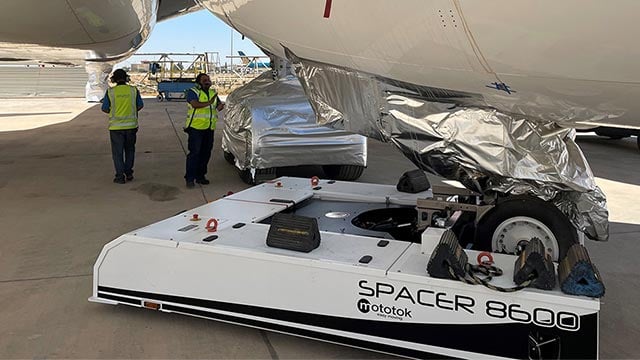


Unique towing challenges in MRO and line maintenance
Every heavy maintenance check or overnight layover involves a choreography of aircraft movements. Jets are towed into docking positions, repositioned between bays, rolled in and out of paint hangars, moved onto engine test pads or brought to remote stands for functional checks. Each move creates risk: the aircraft is often partially disassembled, surrounded by stands and tooling, and guided by teams that may not perform towing as their primary job. A minor misjudgement with a conventional tractor and towbar in this environment can result in damage to structure, engines, landing gear or expensive test equipment – not to mention injuries to technicians.
Historically, MROs and line maintenance providers have mitigated these risks with procedures, training and spotters. But as fleets grow, hangars fill up and skilled labour becomes scarce, the industry is increasingly looking at technology to carry part of the safety burden. Electric, towbarless, remote‑controlled aircraft tugs – originally developed for business aviation, regional aircraft and terminal pushback – are now being adopted for maintenance towing as well. Their promise is simple: give operators better control and visibility, remove high‑risk manual tasks from the process, and enable more precise manoeuvring in tight spaces.
Vendors across the GSE industry are moving in this direction. A recent overview in AviationPros describes how smarter electric machines, from towbarless tractors to compact remote‑controlled tugs, are transforming aircraft movement on the ramp by combining electrification, intelligent controls and more compact designs: AviationPros article on smarter electric tugs. Mototok, for example, has demonstrated in real‑world projects that its Spacer and TWIN series tugs can significantly reduce hangar rash and increase hangar capacity by up to 40–60% compared with traditional tractors and towbars: Mototok business case example. For MRO leaders under pressure to deliver more checks with the same square metres and staff, these are compelling numbers that go far beyond the usual fuel‑savings argument for electrification.
Safety and sustainability expectations are tightening too: airlines working towards IATA's Fly Net Zero goals increasingly expect maintenance partners to show how they manage environmental impact on the ground as well as in the air. Electrifying towing is a visible, auditable measure — and combined with fewer towing‑related incidents, it becomes a strategic differentiator in MRO tenders and long‑term support agreements.
Electric, remote-controlled tugs for tight hangars and aprons
The defining feature of modern electric aircraft tugs for MRO use is not just their power source but their architecture: low‑profile, towbarless and remote‑controlled. Instead of attaching a mechanical towbar, the tug captures the nose gear directly in a hydraulically powered cradle, typically with automatic clamping and release controlled from a handheld remote. This immediately removes several high‑risk tasks from the process: there is no need to manhandle heavy towbars, no risk of using the wrong bar for a given nose gear, and no awkward choreography under the fuselage when disconnecting in tight spaces.
Remote control then changes the operator’s perspective. Rather than sitting in a cab with obstructed sightlines – often below wing or tail level in a hangar – the tug operator can walk to whatever position offers the best view, whether that is in front of the nose, at the wingtip or offset towards a row of stands. This ability to see the entire aircraft and its surroundings is especially valuable in MRO environments packed with tooling, stands, test rigs and partially disassembled aircraft. Mototok’s business case example emphasises how 360° visibility combined with inching control allows operators to position aircraft with millimetre precision while keeping a constant eye on potential collision points: Mototok business case on precise manoeuvring.
Compact dimensions are just as important. MRO hangars and line bays are notoriously space‑constrained, especially for narrow‑body and wide‑body checks where multiple aircraft share the same hall. Traditional tractors require clear approach and exit corridors to make room for their turning radius plus the length of the towbar. Electric towbarless tugs are designed to slip under the nose, pick up the gear and rotate in place, often within the footprint of the aircraft itself. This enables denser parking patterns, nose‑in stacking and creative layouts where tail clearance to the hangar door or docking structure is measured in tens of centimetres rather than metres. Real‑world case studies on Mototok’s website report hangar capacity increases of 40–60% after switching from towbar operations to remote‑controlled tugs: Mototok guide on hangar efficiency gains.
Electric drive systems contribute additional advantages. Because eTugs deliver high torque from standstill and offer very fine speed control, they are particularly well suited for delicate movements such as docking an aircraft into a nose dock, aligning with engine access stands or rolling an aircraft onto weighing platforms. Regenerative braking and precise traction control reduce the risk of jerky motion that might otherwise stress nose gear. And because there are no exhaust fumes, noise and heat around the nose, technicians can safely stay closer to the aircraft during final positioning. This is a non‑trivial improvement for teams that perform multiple short moves per shift during heavy maintenance checks.
From a safety‑of‑flight perspective, these characteristics align closely with recommendations from regulators and industry bodies that emphasise robust towing procedures as part of continuing airworthiness and maintenance human‑factors programmes. While specific guidance on electric tugs is still emerging, the general trend in aviation mirrors what is already mainstream in other sectors: automation, better visibility and smarter equipment reduce human error in repetitive, high‑risk tasks.
Implementing eTugs safely in maintenance organisations
Introducing electric, remote‑controlled tugs is not just a procurement decision; it is a change‑management project touching procedures, training, safety governance and labour relations:
- Risk assessment and SOP design: map all typical towing scenarios (aircraft type, configuration, hangar layout, stand positions, engine run procedures) and identify where towbarless eTugs will be used.
- Update towing procedures accordingly: operator position, communication with brake riders or flight crews, speed limits, emergency stop functions. IGOM and AHM provide a useful framework, even though written for airline ramp operations: IATA Ground Operations Manual.
- Training: eTugs are intuitive but require disciplined handling – combine classroom elements (capabilities, limitations, safety features) with supervised hands‑on sessions in progressively complex scenarios, and build recurrent training and sign‑off into your exposition. Many incidents occur after staff changes, rapid growth or when new equipment is introduced without sufficient practice time: AviationPros article on preventing ground damage.
- Infrastructure: energy demand is modest – start with standard three‑phase outlets in hangars and staging areas, then refine charging based on utilisation data. Telematics and fleet‑management tools help optimise deployment: AviationPros article on smarter electric ramp equipment. Built‑in diagnostics and remote support ease the load on in‑house teams.
- Governance: involve safety committees, quality departments and, where applicable, works councils early to review risk assessments, training plans and pilot data.
- KPIs: towing‑related incident rates, near‑miss reports, hangar capacity utilisation and average time per movement – to separate perception from fact and refine procedures on evidence.
Successful implementations expand from a few high‑impact use cases (for example, narrow‑body nose‑in docking at a flagship hangar) to standard practice across the hangar network – until remote‑controlled tugs are simply "how we move aircraft here".
FAQ:
An electric towbarless aircraft tug is a remote-controlled ground vehicle that lifts and clamps an aircraft's nose gear directly in a hydraulic cradle instead of connecting via a mechanical towbar. This eliminates the need to select, attach, and manhandle a towbar, and removes several manual, high-risk steps from the towing process.
MROs are adopting electric tugs to reduce hangar rash, improve operator visibility in cramped hangars, and increase hangar capacity. Case studies report capacity gains of 40–60% compared with traditional towbar operations, alongside fewer towing-related incidents.
Real-world deployments, such as those documented by Mototok, show hangar capacity increases of up to 40–60% after switching from towbar-based tractors to remote-controlled electric tugs, mainly due to their compact footprint and ability to manoeuvre within tight clearances.
Safe implementation typically follows four phases: risk assessment and SOP design (often using IATA's IGOM and AHM as a framework), operator training with supervised hands-on sessions, charging and infrastructure readiness, and governance involving safety committees and clear KPIs to track incident rates and utilisation.
Yes. Electrifying towing and ground support equipment gives MROs a visible, auditable way to reduce ground-side environmental impact, supporting airline customers working toward IATA's Fly Net Zero goals, while also improving safety through reduced towing-related incidents.
Comments