
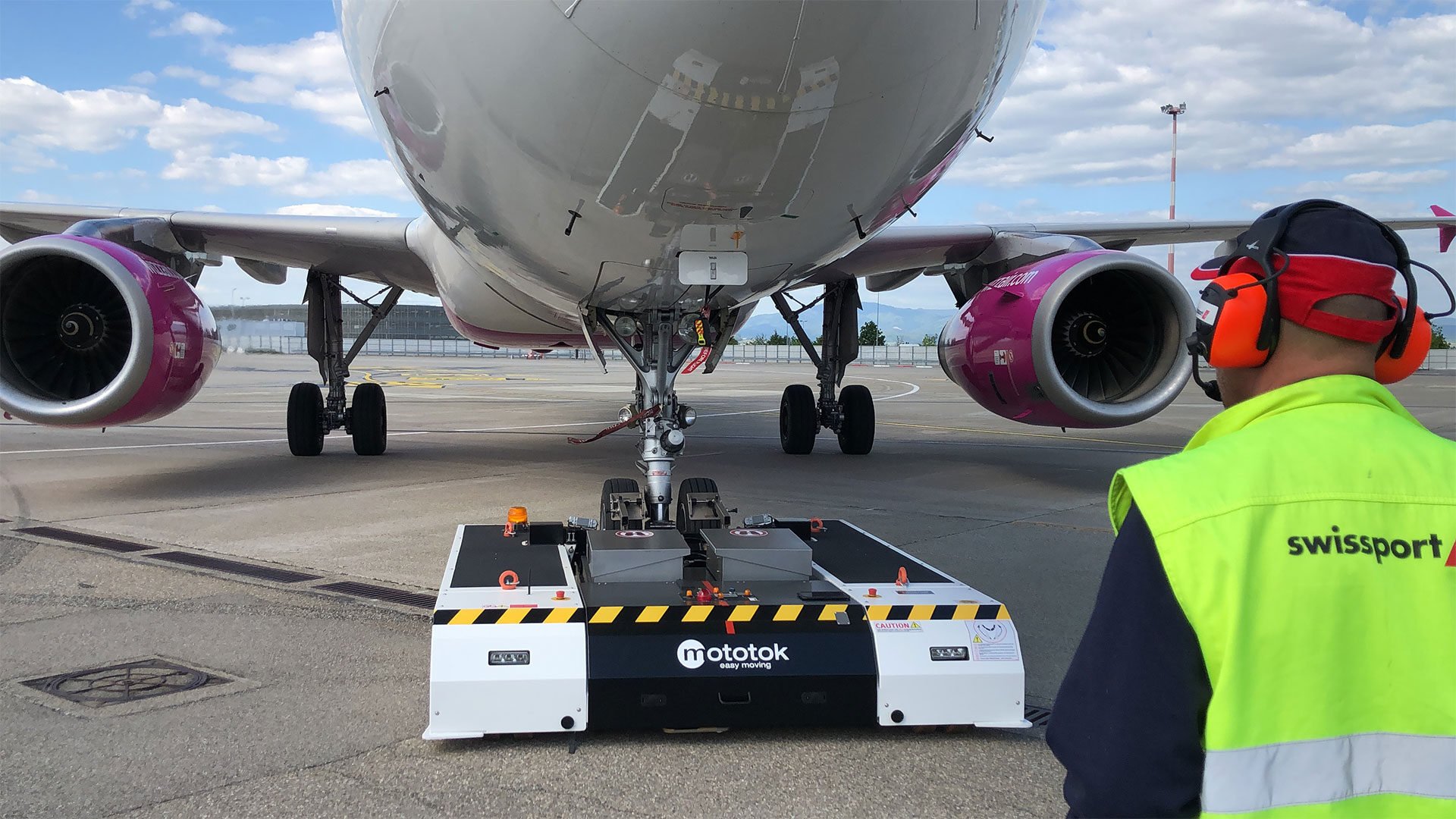


Aircraft ground handling operations face persistent safety challenges that directly impact operational costs and aircraft availability. Here are a five efficiency components to focus in on:
Nose gear damage represents one of the most significant preventable incidents in ground support operations, with conventional towbar tractors and manual positioning methods contributing to mishaps that can ground aircraft for extended periods.
Remote-controlled, towbarless electric tugs provide measurable safety improvements through hands-free automatic nose gear connection systems that eliminate human error factors associated with traditional towbar attachment procedures.
"Towbarless remote systems prevent nose gear damage with accurate automatic connections."
Quantifying safety improvements requires establishing baseline incident rates and calculating reduction percentages following implementation of advanced ground support equipment. Remote-controlled aircraft tugs equipped with precision positioning capabilities reduce nose gear contact incidents by eliminating manual alignment while operators no longer need to work in close proximity to the aircraft.
The unobstructed view provided by remote operation allows operators to maintain visual contact with the aircraft nose gear throughout the entire movement sequence, ensuring accuracy during connection and disconnection procedures that complete in 10–15 seconds.
Financial Impact of Preventing Nose Gear Damage
Each nose gear incident typically results in:
- Maintenance inspection costs
- Component replacement expenses
- Aircraft downtime and revenue loss
- Increased insurance implications
By tracking incident frequency before and after equipment modernization, operators can calculate annual cost savings and ROI. Key safety indicators should include:
- Incident rate per aircraft movement
- Damage severity classification
- Mean time between safety events
Hangar space represents a critical constraint for MRO facilities, FBOs, and corporate flight departments seeking to maximize revenue capacity while maintaining operational flexibility. The compact, low-profile design characteristics of remote-controlled electric aircraft tugs enable optimization of hangar layouts through reduced maneuvering clearances and elimination of traditional tractor turning radius requirements. Measuring hangar space utilization efficiency requires calculating aircraft density metrics, analyzing movement pathway requirements, and determining the incremental revenue capacity gained through optimized positioning strategies.
“Optimizing aircraft positioning within existing hangar infrastructure can unlock significant additional revenue without expanding physical space.”
Space utilization calculations should account for the reduced footprint requirements of towbarless systems compared to conventional sit-down tractors with towbar configurations. Remote-controlled tugs enable precise aircraft positioning with minimal clearance margins, allowing facilities to reconfigure hangar layouts for increased aircraft storage capacity. By measuring the square footage required per aircraft under conventional handling methods versus remote-controlled towbarless systems, operators can quantify the additional aircraft capacity achievable within existing infrastructure.
This analysis becomes particularly valuable for facilities operating at maximum capacity, where adding a single additional aircraft position can generate significant annual revenue increases.
Revenue capacity modeling must incorporate aircraft type mix, average daily rates, utilization percentages, and seasonal demand variations to accurately project financial gains from improved space efficiency. For MRO operations, increased hangar capacity directly translates into reduced customer queue times and enhanced service delivery capabilities. FBO facilities benefit from accommodating additional transient aircraft during peak periods, while corporate flight departments gain flexibility for fleet expansion without facility construction costs. Comprehensive efficiency calculators should include inputs for current hangar dimensions, aircraft specifications, movement frequency requirements, and revenue per aircraft position to generate actionable optimization recommendations.
Establishing Key performance indicators (KPIs) provides the foundation for measuring ground handling efficiency and identifying optimization potential. Key metrics include aircraft movement cycle time, operator productivity, equipment utilization rates, and energy consumption per movement.
Remote-controlled electric tugs generate detailed operational data through programmable controls and Wi-Fi diagnostics, enabling real-time performance monitoring and historical trend analysis.
“What gets measured gets optimized — cycle time and utilization rates define true operational efficiency.”
Movement cycle time includes the full sequence from equipment deployment to nose gear connection, aircraft positioning, disconnection, and return. Conventional towbar tractors often require multiple operators and extended alignment procedures.
In contrast, remote-controlled towbarless systems reduce connection time to 10–15 seconds, enable single-operator handling, and minimize repositioning requirements. Measuring average cycle time reductions across aircraft types provides quantifiable efficiency gains that translate directly into labor savings and higher throughput.
Equipment Utilization & Energy Metrics
Equipment utilization tracks the percentage of time ground support equipment is actively engaged versus idle or in maintenance. Electric tugs eliminate fuel costs and reduce maintenance requirements, resulting in higher operational availability compared to diesel or gasoline tractors.
Energy analysis should measure kilowatt-hours per aircraft movement, comparing electric efficiency with fossil fuel alternatives while factoring in cost and environmental impact.
“Higher utilization with lower operating cost per movement creates measurable ROI from day one.”
Integrated performance dashboards allow operations managers to benchmark performance, identify trends, and justify capital investments using data-driven frameworks.
Ground support efficiency metrics directly influence operational profitability across multiple cost centers, including labor expenses, equipment maintenance, energy consumption, and facility utilization. Understanding how these factors interact enables aviation operations managers to identify high-impact optimization opportunities and prioritize investments that deliver measurable financial returns. Remote-controlled electric aircraft tugs improve several efficiency dimensions simultaneously, creating compounding operational and financial benefits rather than isolated performance gains.
Labor Efficiency
Labor cost analysis remains a primary component of ground handling efficiency, as personnel expenses typically represent the largest operational cost category. Traditional aircraft towing requires specialized staff and extensive training in towbar attachment and tractor handling. In contrast, remote-controlled towbarless systems simplify operations, reduce training time, and enable cross-functional staff deployment, eliminating the need for dedicated towing specialists. Measuring efficiency gains therefore involves evaluating operator hours per movement, training investments, and labor rate differentials, providing a clear framework for cost reduction analysis.
Equipment Lifecycle Economics
Equipment lifecycle costs further determine total cost of ownership, encompassing capital expenditure, maintenance, energy consumption, downtime, and residual value. Electric tugs offer superior lifecycle economics by eliminating fuel costs, reducing maintenance requirements compared to combustion engines, and extending service intervals through simplified electric drivetrains. A comprehensive cost comparison should integrate scheduled service expenses, unplanned repairs, and downtime impacts. When combined with safety improvements, space optimization, and increased throughput, these metrics create a holistic efficiency model that captures the full bottom-line impact of modern ground support equipment.
Aircraft turnaround time is one of the most critical performance indicators in airline, MRO, and FBO operations, as schedule adherence directly influences revenue generation, customer satisfaction, and operational reliability. Ground handling procedures—particularly aircraft positioning, pushback, and hangar movements—represent significant time drivers that can quickly become operational bottlenecks.
A data-based turnaround optimization strategy begins with measuring current timelines and identifying procedural inefficiencies. Traditional towbar attachment processes involve multiple manual steps, including tractor positioning, alignment, connection verification, and safety checks. In contrast, remote-controlled towbarless systems complete automatic nose gear connection in 10–15 seconds, reducing connection time by 70–80% compared to conventional methods.
These time savings do not remain isolated. They compound across multiple daily movements, increasing throughput and enabling higher operational capacity without additional staffing. Over time, this translates into measurable efficiency gains within existing shift structures and infrastructure.
Advanced automation capabilities, including AGV integration with millimeter-level positioning accuracy, further enhance turnaround performance. By reducing manual dispatch requirements, minimizing human error, and enabling parallel aircraft movements, automated systems improve both process reliability and operational scalability.
Ultimately, the financial impact of reduced turnaround times extends beyond labor savings. Increased aircraft throughput, improved schedule reliability, and enhanced service quality contribute directly to competitive positioning and long-term revenue growth. When modeled correctly—factoring in movement frequency, time saved per cycle, labor rates, and revenue per aircraft turn—turnaround optimization provides a clear, data-driven return on investment framework for modern ground support equipment decisions.

Comments