


Aircraft ground damage is one of the most underestimated cost drivers in aviation. IATA estimates the global bill could reach USD 8 billion annually by 2030 — and up to USD 10 billion by 2035 — if incident rates are not reduced.
A large share of these events are directly linked to ground support equipment (GSE): wrong towbar connections, limited driver visibility, and miscommunication between ramp crews. Electric towbarless tugs address several of these root causes simultaneously, offering a measurable path to fewer incidents, lower repair costs, and safer working conditions on the ramp. IATA defines Enhanced GSE as ground support equipment fitted with active safety features — such as anti-collision sensors, speed limiters, and precision inching controls — that reduce the margin for human error during ramp operations.
Most towing-related ground damage is not caused by a single catastrophic mistake. It is the result of small weaknesses in process, visibility, and equipment design that align at the wrong moment.
With conventional diesel tractors and mechanical towbars, the structural weak points are well known:
- The driver sits in a fixed cab with limited sightlines, relying on wing-walkers to judge wingtip and engine nacelle clearances
- Communication breakdowns between driver, headset operator, and wing-walkers create gaps in situational awareness
- Long towbars swing in a wide arc, increasing the risk of contact with adjacent GSE, cones, or parked aircraft
- Using the wrong towbar or connecting it incorrectly can damage nose gear doors and fairings before the aircraft even moves
"Every movement requires tight communication between people who cannot always see what the others see."
IATA's 2024 ground handling priorities highlight that Enhanced GSE — equipment with anti-collision features, inching capabilities, and precision control — can reduce ground damage by more than 40 percent when combined with solid procedures and training.
Electric towbarless tugs remove several of the structural weaknesses that lead to conventional towing incidents.
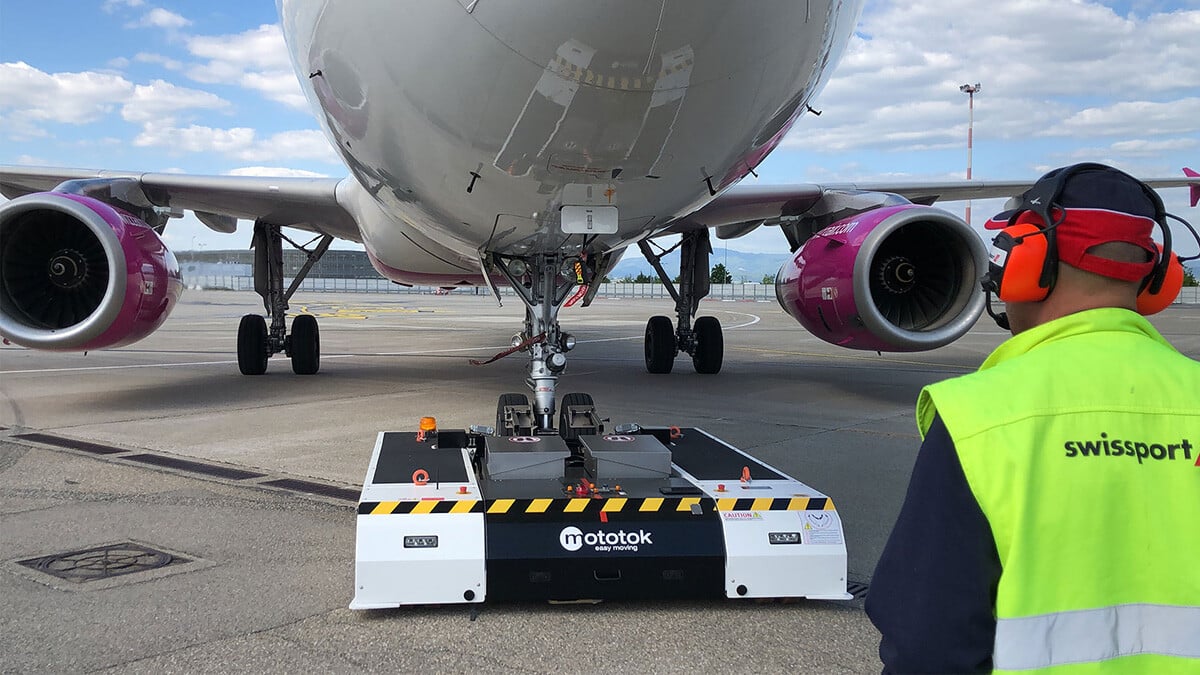
No towbar — no towbar-related damage: The tug cradles the nose gear directly in a hydraulically controlled, sensor-monitored cradle, eliminating the risk of wrong towbar selection, incorrect connection, or fairing damage during attachment. Built-in nose gear protection automatically keeps torque and steering angles within safe limits, even during tight manoeuvres.
360° remote control replaces fixed cab operation: Instead of steering from a cab with blind spots, the operator walks alongside the aircraft with a handheld remote. This merges the traditional roles of tug driver and wing-walker into one highly aware operator with a full view of wings, tail, and surrounding equipment.
- The operator can stop and reposition at any point during the movement
- Inching speed past tight obstacles becomes straightforward
- In hangars, this dramatically reduces hangar rash — the scrapes and dents caused when aircraft meet concrete or equipment in confined spaces
Predictable, engineered behaviour: Electric tugs with proximity sensors, automatic braking, and soft start/stop systems turn towing from a feel-based skill into a more repeatable, engineered process — easier to standardise, easier to train, and easier to audit.
The direct repair cost of a single ground damage event averages around USD 18,000 — but the total impact is far higher. Once missed connections, crew repositioning, and passenger compensation are factored in, disruption costs can be four to ten times the direct repair bill. One avoidable pushback incident can easily wipe out an entire season of fuel savings on that aircraft type.
Electric towbarless tugs also reshape the operating cost structure of towing itself:
- No diesel fuel during long idle periods
- No engine oil changes, exhaust aftertreatment, or combustion-related wear parts
- Fewer moving parts in the drivetrain mean lower maintenance frequency and cost
- Higher operational availability compared to diesel tractors
Mototok's business case analysis points to potential annual savings of up to USD 175,000–204,500 per tug when reduced ground damage, personnel savings, lower maintenance, and improved hangar utilisation are fully considered.
"For airlines and handlers, even a small reduction in their share of the global ground damage bill is worth serious attention."
A robust ROI model starts with quantifying the baseline across five areas:
- Ground damage frequency and cost — number of towing-related incidents per year and average direct + indirect cost per event
- Towing-related incident share — what percentage of total ground damage is linked to towing operations specifically
- Maintenance and fuel spend — current annual cost of running diesel tractors including scheduled and unplanned maintenance
- Personnel hours — time spent by drivers, wing-walkers, and cockpit crews per towing movement
- Hangar utilisation — current aircraft density versus what is achievable with towbarless equipment
From this baseline, realistic reduction assumptions can be applied. A 30–40 percent drop in towing-related incidents after introducing electric towbarless tugs and Enhanced GSE procedures is consistent with IATA's projections for Enhanced GSE adoption. Even conservative modelling typically shows payback periods of three to five years, after which savings accumulate year after year.
Beyond safety and direct cost savings, electric towbarless tugs deliver measurable improvements across several operational dimensions:
Sustainability: Fully electric drivetrains eliminate local emissions from towing operations entirely. For airports engaged in Airport Carbon Accreditation or airline Net Zero programmes, electric tugs are a visible, fast win in Scope 1 emissions reduction.
Workforce: Quiet operation, no exhaust, and intuitive remote controls make the ramp a more attractive working environment — relevant in a labour market where experienced ramp staff are increasingly difficult to recruit and retain. Training time is also significantly reduced: ANA reported that operator training time was cut by half after introducing the Mototok Spacer 8600.
Hangar efficiency: The compact footprint and pivot-turn capability of electric towbarless tugs allow aircraft to be parked closer together. According to Simple Flying, operators using Mototok tugs have achieved hangar capacity increases of up to 160 percent within existing infrastructure.
Fewer movements, less risk: Because compact electric tugs can operate safely in spaces where conventional tractors do not fit, hangars and aprons can be laid out to minimise unnecessary repositioning moves — and fewer movements mean fewer opportunities for something to go wrong.
The Bottom Line
Ground damage is expensive, largely preventable, and growing. IATA projects the global cost could reach USD 10 billion annually by 2035 — but also confirms that Enhanced GSE adoption can reduce damage rates by more than 40 percent. Electric towbarless tugs are a proven, available technology that directly addresses the root causes of towing-related incidents while simultaneously reducing operating costs, emissions, and training burdens.
For airlines, MROs, FBOs, and ground handlers willing to evaluate equipment on total cost of ownership rather than purchase price, the case is compelling — and the window to act ahead of rising incident costs is now.
Comments