
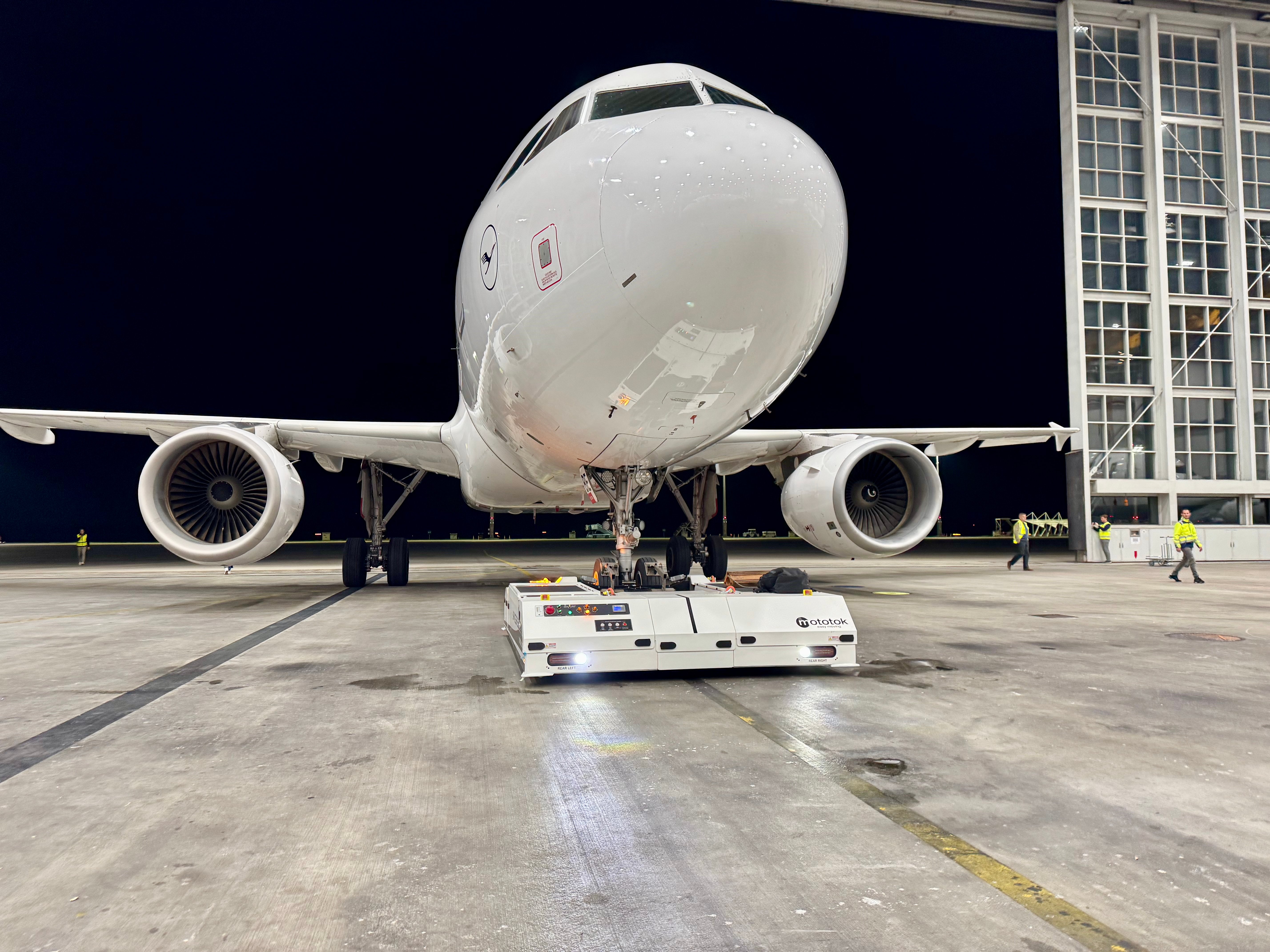


The way aircraft are towed on the ground is changing. Diesel-powered tractors with mechanical towbars have dominated ramp operations for decades — but electric aircraft tow equipment is rapidly becoming the standard for airlines, MRO facilities, FBOs, and military operators worldwide.
Whether you are evaluating your first electric tug or planning a full fleet transition, these are the five questions ground handling professionals ask most.
An electric aircraft tow — also called an electric towbarless tug — is a battery-powered ground support vehicle that moves aircraft without the need for a mechanical towbar. Instead of attaching a metal bar to the nose gear, the tug cradles the nose gear directly in a hydraulically controlled, sensor-monitored platform that automatically engages and lifts the wheel in 10 to 15 seconds.
The operator controls the tug remotely via a handheld radio remote control, walking alongside the aircraft rather than sitting in a fixed cab. This gives the operator a full 360° view of the aircraft, wings, tail, and surrounding equipment at all times.
Key technical characteristics of modern electric aircraft tugs include:
- Fully electric drivetrain — zero local emissions, low noise
- Differential steering controlled independently by microprocessors
- Pivot-turn capability — the nose gear rotates without requiring the aircraft to move forward or backward, eliminating lateral shear forces on the landing gear
- Automatic oversteering protection and counter-steering systems
- Industrial-frequency remote control with international safety approval for airport use
Mototok manufactures electric towbarless tugs for aircraft ranging from light business jets up to 200-tonne (441,000 lbs) commercial airliners, including models compatible with the Airbus A320 and Boeing 737 families.
Conventional diesel tractors with mechanical towbars introduce multiple structural weak points into every towing movement: limited cab visibility, communication dependencies between driver and wing-walkers, and the risk of towbar misconnection. Electric towbarless tugs are engineered to remove these weak points.
Elimination of towbar-related incidents: Because there is no mechanical towbar, there is no risk of selecting the wrong bar, connecting it incorrectly, or damaging nose gear doors and fairings during attachment. The automated nose gear cradle system ensures a consistent, repeatable connection every time.
Single-operator, 360° visibility: The remote-control operator walks with the aircraft, maintaining direct sight lines to wingtips, fuselage, and nose gear throughout the movement. This effectively merges the roles of tug driver and wing-walker into one aware operator — reducing both staffing requirements and communication risk.
Hangar rash prevention: In confined hangar environments, the operator can stop, reposition, and continue at inching speed past tight obstacles. ANA (All Nippon Airways) reported that their ground handling staff noted significantly improved situational awareness after switching to the Mototok Spacer 8600, compared to a conventional seated towing vehicle.
"IATA's 2024 ground handling priorities confirm that Enhanced GSE — equipment with anti-collision features and precision control — can reduce ground damage by more than 40 percent."
Modern electric towbarless tugs cover a wide range of aircraft types. Mototok's product lineup spans five series, each targeting a different segment:
- M-Series — light aircraft, most wheeled helicopters, and smaller business jets up to 28 tonnes (61,700 lbs). Designed for FBOs, corporate flight departments, and MRO facilities
- TWIN-Series — medium to large business jets and wheeled helicopters up to 75 tonnes (165,300 lbs), including models for regional commercial aircraft pushback (Embraer jets, Bombardier CRJs, de Havilland turboprops)
- SPACER-Series — commercial airliners including wide-body aircraft up to 200 tonnes (441,000 lbs). The SPACER 8600 NG handles narrow-body pushback for Airbus A320 and Boeing 737 variants up to 105 tonnes
- LB-Series — military helicopters and fixed-wing aircraft up to 75 tonnes (165,300 lbs), with optional saltwater resistance and magnetic arresting systems for aircraft carrier operations
- Alligator-Series — helicopters with low ground clearance due to undercarriage-mounted FLIR systems, radar, or cameras; uses a patented clamp mechanism to engage the nose wheel
One tug can typically handle multiple aircraft types within its weight class — eliminating the need to swap towbars between movements.
The purchase price of an electric towbarless tug is higher than a conventional diesel tractor. But total cost of ownership (TCO) over the full equipment lifecycle tells a different story.
Operating cost advantages of electric tugs:
- No diesel fuel — energy cost per movement is substantially lower
- No engine oil changes, exhaust aftertreatment, or combustion wear parts
- Longer service intervals and fewer unplanned repairs due to simpler electric drivetrain
- Higher operational availability — electric tugs are maintenance-free in daily operation according to Mototok
Revenue and productivity gains:
- Iberia Airport Services calculated that each Mototok pushback tug saves approximately 23 metric tonnes of CO₂ per year versus a diesel equivalent — with direct financial value for carbon accreditation programmes
- British Airways reported a 54 percent reduction in departure delays at Heathrow Terminal 5 after introducing Mototok SPACER 8600 NG tugs
- Compact towbarless equipment allows hangar capacity increases of up to 160 percent within existing infrastructure, according to Simple Flying
A complete TCO model should include: capital expenditure, energy costs per movement, scheduled and unplanned maintenance, downtime cost, personnel hours per movement, and residual value at end of service life.
In 2025, Mototok established Mototok Corporation, a dedicated subsidiary in Atlanta, Georgia, to support the growing demand for electric towbarless tugs across the North and South American market. The U.S. subsidiary brings Mototok's full product lineup — including the SPACER 8600 NG, TWIN-Series, and M-Series — closer to American airlines, MRO facilities, FBOs, and military operators.
The U.S. aviation market represents a significant opportunity for electric aircraft tow adoption:
- North American airlines operate thousands of narrow-body A320 and B737 movements daily, where electric pushback tugs deliver the most measurable turnaround benefits
- MRO facilities across the country are under increasing pressure to reduce ground damage costs and improve hangar efficiency
- Military operators require specialised towing solutions for helicopters and fixed-wing aircraft, including carrier-based operations — an area where Mototok's LB-Series and Alligator-Series are purpose-built
"The establishment of Mototok Corporation reflects the global shift toward electric ground support equipment as airlines, airports, and defence operators move to decarbonise their ground operations."
Mototok's global network of sales and service partners ensures local support for customers across the Americas, backed by the engineering expertise and track record of over two decades of electric towbarless tug development.
The Bottom Line
Electric aircraft tow technology has moved well beyond the pilot phase. Airlines like British Airways, ANA, and Iberia have documented measurable results — fewer delays, lower emissions, reduced ground damage, and simpler workforce management. The technology covers everything from light business jets to 200-tonne (441,000 lbs) commercial airliners, and with the establishment of Mototok Corporation, North and South American operators now have direct access to sales and service support.
For ground handlers, MRO facilities, and airlines evaluating their next tug fleet decision, the question is no longer whether electric towbarless tugs deliver — it is how quickly the transition can begin.
Comments